Lydia has a professional and academic background spanning the museum, heritage and maritime sectors
In partnership with The University of Portsmouth’s School of Mathematics and Physics.
This page is approximately a 2 minute read
This page was published on
This project's duration was 4 years
£772,372
The University of Portsmouth’s School of Mathematics and Physics aims to solve technological, environmental and societal problems through pioneering research and teaching.
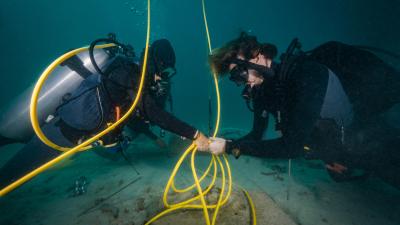
The University of Portsmouth is leading a new international research project to improve the safety and resilience of critical undersea infrastructure. Funded by Lloyd’s Register Foundation, the project will design a surveillance system to detect risks early and reduce damage to power and communications cables. The goal is to support faster repairs and minimise disruption to essential services. With global reliance on subsea networks growing, this work will help protect vital connections and keep systems running smoothly when incidents occur.
The team includes Professor Dylan Jones, Professor Ashraf Labib, Dr Banafsheh Khosravi, and Dr Negar Akbari, working with partners from Brazil’s Federal University of Rio Grande do Norte and Cebu Technological University in the Philippines. The research will focus on safety challenges in both countries, where undersea infrastructure is increasingly under pressure.
In Brazil, the growth of offshore wind has highlighted the need for stronger safety policies. Key challenges include shallow waters, overlap with oil and gas pipelines, ecological protection, and limited infrastructure and trained personnel. The project aims to support practical solutions and safer systems.
The focus for this project will be undersea infrastructure safety in Brazil and the Philippines - two countries experiencing rising and differing issues. Loss of an energy supply or internet, for example, leading to interruption in services that are relied on to function daily and to do business which can have severe consequences for society and the economy. This is a matter of growing concern worldwide.
Professor Dylan Jones Professor of Operational Research, School of Mathematics and Physics, University of Portsmouth
We have recently awarded funding to the University of Portsmouth’s School of Mathematics and Physics to explore undersea infrastructure safety.
Discovering Safety joins forces with Safetytech Accelerator to build a Smarter Regulation Sandbox.
In this blog, our Chairman, Thomas Thune Andersen, emphasises why ports must adapt to the increasing challenges of climate change, and discusses how a nature-positive approach to port development can support sustainable economic growth and environmental stewardship.