Advancing seafarer safety and readiness: a performance support approach

This page is approximately a 4 minute read

This page was published on

Page author

Christopher Peterson, Founder, Voyage Solutions (Skipa)

In complex environments, safety depends on more than training alone. It depends on having the right information at the right moment. With funding from Lloyd's Register Foundation, Voyage Solutions developed Skipa, a tool that helps bridge teams observe, interpret and share critical ice condition data in real time, supporting safer decision-making in polar navigation.
 

Closing the gap between training and practice

In some maritime environments, safe operations depend on decisions being made quickly and with limited information. This challenge is particularly acute in polar regions, where weather and ice conditions can change rapidly and small decisions can have significant operational consequences. 

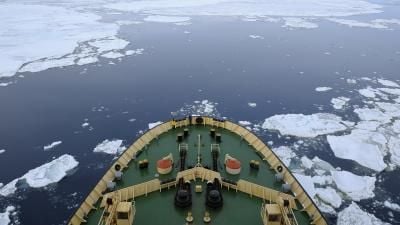
During an Antarctic research expedition, a bridge team faced precisely this challenge while navigating through pack ice en route to Rothera Research Station. Despite having the necessary training, charts and operational expertise, determining the safest course of action depended on obtaining up-to-date information about conditions beyond the visible horizon. 

A flyover by a research aircraft provided a clear picture of the ice conditions ahead, enabling the vessel to proceed safely. The experience underscored a broader point: in complex environments, safety often depends not only on what people know, but on having access to the right information at the right moment. 

This principle, known as performance support, became the foundation of a Lloyd's Register Foundation-funded pilot project exploring how operational guidance can support safer decision-making in polar navigation. 

The gap in polar navigation

Ice navigation sits at a unique intersection of technical analysis, ship handling instinct, and the ability to anticipate conditions that change by the hour.  

The industry has made meaningful advances in safety. The International Maritime Organization’s Polar Code provides a vital regulatory framework, including mandatory Basic and Advanced training, along with the Polar Operational Limit risk tool to help teams assess operational limits. Furthermore, highly experienced, expert ice navigators called Ice Pilots are available to integrate with the bridge team to execute the voyage.  

However, as maritime activity in polar regions grows, a gap remains. Regulations and training set the standard, but they don't always support the officer on watch who is still developing their skills in real-time, under real conditions.  

What the pilot project showed

We launched a pilot project which introduced a different, complementary approach to this safety challenge: workflow performance support. Widely used in aviation and healthcare, the principle is straightforward: actionable information delivered at the point of work closes the gap between what people are trained to do and what they actually do. 

The pilot project tested an operational performance support system with a major vessel operator, working directly with seafarers to address a practical challenge: identifying ice conditions and understanding the risks they present to vessel operations. 

A key finding was the lack of ground truth ice condition data in nearby areas of operation, leaving seafarers without a shared, structured picture of what conditions existed around them and how those conditions affected the vessel and its intended route. 

Building the solution: Skipa

To address this challenge, the project developed an Operational Performance Support System called Skipa. It is a tablet-based application that guides bridge teams through structured ice observation at the point of work.  

Screenshot of SKIPA app's Monitor screen showing sea ice concentration and stage of development data.

As an officer logs what they see, the system surfaces perceptual cues: what thick first-year ice looks like visually, what a ram on an iceberg means for safe distance, and the visual characteristics of glacial ice.

Screenshot of the SKIPA app's Monitor interface showing glacial ice observation categories, with Icebergs selected.

Every observation is logged and plotted on a live map, creating a shared picture of conditions that grows with every watch. 

Screenshot of SKIPA app showing an Arctic map with sea ice observations and a data tooltip.

A broader finding for maritime safety

This pilot project revealed that this "perceptual gap" extends beyond ice navigation. Following the project, through conversations with seafarers and equipment manufacturers, a pattern emerged: the technical details to inspect, maintain, and operate safety-critical equipment are scattered across various resources, information systems, and not available at the point of work. As a result, shipboard teams are frequently acting on inconsistent or incomplete information, with no standardised way to reference what to look for, record what they observe, or share what the next person needs to know.  

What comes next

It highlighted an important opportunity for the maritime sector: while significant investment has been made in preparing those at sea before they begin work, there is also value in supporting decision-making and learning during operations. If you are interested in how performance support can reduce operational risk for your operations, find me on LinkedIn or at chris@voyagesolutions.co.