Rewriting Women into Maritime makes London International Shipping Week debut
Rewriting Women into Maritime makes London International Shipping Week debut.
This page is approximately a 5 minute read
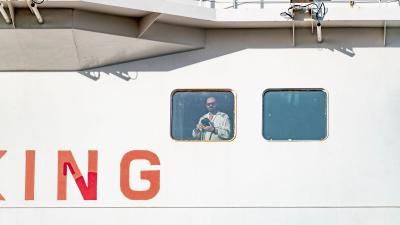
When Cezar Gabriel comes home from sea, it takes time to adjust.
After weeks or months aboard an oil tanker, surrounded by water, machinery, routine and a small crew, life on land takes time to ease into. He has been home for three weeks when he speaks about it, and says it usually takes about a month to feel fully settled again.
What he misses most is simple: “Everything. My home. My wife. My dogs and my life here.”
Cezar is a chief engineer and photographer who has spent more than 20 years working at sea. He began his career in 1999 and has worked on tankers ever since. Seafaring runs through his family: two uncles worked at sea, and his father worked as a superintendent for a Romanian shipping company.
Cezar says that, for many people, ships are simply “big metal things floating around there. They do not think about the real people living and working on board. But there are real people with real stories, real lives on board those vessels,” he adds, “keeping them moving and basically keeping the world economy moving.”
In short, more than 90% of the goods people use are transported by sea - and behind that system are seafarers working day and night, often far from home. This became the heart of his photography.
Cezar began taking photographs at sea around 15 years ago. At first, he photographed the sea itself: sunsets, sunrises, weather and distant horizons. Over time, his camera turned towards his crewmates and the daily life of the ship.
Photography became both a creative outlet and a way of coping with the pressures of life on board.
“It helped me just deal with everyday stuff that we had on board,” he says. “Problems and stress and loneliness.”
It also became a form of memory: a visual diary documenting the work and people around him. After so many years at sea, he cannot remember every name, though he remembers faces and stories.
“I think they deserve to be known one way or another,” he says, “even though it’s only in a photograph.”
That desire to make seafarers visible sat at the centre of Exposure: Lives at Sea, a previous exhibition at the National Maritime Museum, part of Royal Museums Greenwich. The exhibition brought together photography taken by people working in the maritime industry, offering the public a view of life at sea through the eyes of those who know it from the inside.
Cezar’s photographs were included alongside work by other seafaring photographers and researchers. Through images and personal accounts, the exhibition helped audiences understand the physical demands, isolation and psychological pressures faced by people whose work underpins global trade.
For Royal Museums Greenwich, this is part of a wider commitment to connecting historic maritime collections with contemporary maritime issues. Since 2018, Lloyd’s Register Foundation has supported the Senior Curator of Contemporary Maritime role at the National Maritime Museum. The role was created to help increase public awareness and understanding of modern maritime life, including global trade, migration, environmental change, technological transformation and life at sea. The team has grown to three curatorial posts supported by the Foundation.
For Cezar, seeing his work included in the exhibition felt surreal, even though he never had the chance to visit it in person. He saw photographs and film from the gallery instead.
“I’ve never had my own wall with my face on it, and my story there,” he says. “I wasn’t used to it, but it was nice. It was a great experience. I felt honoured.”
Cezar describes life at sea as a “very, very tumultuous relationship.”
“It takes a special kind of person to be able to do that job,” he says. “It takes dedication and it takes courage, and it takes passion.”
“We are basically isolated there,” he continues. “If you’re lucky, then you get at least one person on board that you can talk to and just satisfy this need for human connection. But there are times when you are completely alone.”
During the pandemic, that isolation became sharper. Cezar left home expecting to be away for three months and stayed on board for seven.
“There was a lot of talk back then about key workers,” he says. “But seafarers were never mentioned in that context.”
While much of the world stayed home, ordered goods and depended on supply chains, ships kept moving.
“We never stopped,” he says. “We kept moving.”
That experience made him want to tell seafarers’ stories even more.
Museums can help close the distance between the public and the people behind maritime systems. By placing Cezar’s images in the National Maritime Museum, Royal Museums Greenwich invited visitors to look beyond ships as objects and see the people who make them work.
Cezar says life at sea has taught him humility.
“I learned that nobody is above anybody else,” he says. “It doesn’t matter where we come from, what kind of flag we have flying above our heads. The things that we have in common are way more than the things that separate us.”
Through Lloyd’s Register Foundation’s support for contemporary maritime curation, Royal Museums Greenwich is helping stories like Cezar’s reach people who may never step on board a tanker or see the horizon from the middle of the sea.
For Cezar, photography remains personal. In every image, he says there is “a piece of me there, a piece of my soul.”
That is what makes the work powerful. It gives the public more than a glimpse of maritime labour. It gives them a human connection to a life that is often out of sight, but never separate from their own.
It takes a special kind of person to be able to do this job. It takes dedication and it takes courage, and it takes passion.
Cezar Gabriel Chief Engineer and Photographer
Rewriting Women into Maritime makes London International Shipping Week debut.
In this podcast, Lloyd's Register Foundation‘s Louise Sanger and Benjamin Ferrari discuss the catastrophic impact polluting wrecks are having on our oceans.
After its launch at last year’s London International Shipping Week, our SHE_SEES exhibition is opening at the Portsmouth Historic Dockyard.