New technologies to improve health and safety performance
Discovering Safety joins forces with Safetytech Accelerator to build a Smarter Regulation Sandbox.
This page is approximately a 5 minute read
Around the world, coastal communities depend on structures built to hold back the sea.
Sea walls, flood barriers and other coastal defences protect homes, roads, railways, businesses and public spaces from waves, storm surges and flooding. Yet, many of them were designed for the conditions of the past, and now those conditions are changing.
As the climate warms, sea levels rise, and storms become more intense. This creates a new challenge for engineers, coastal authorities and policymakers: how will existing defences perform in the future, when the sea behaves in a different way?
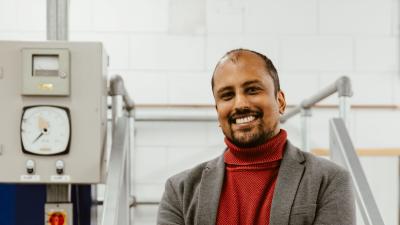
For Dr David McGovern, Principal Investigator on the COASTVUL-SLR project in the Coastal Hazards Research Group at London South Bank University (LSBU), that uncertainty is the starting point.
“We have a lot of coastal defences, which are very important to mitigate the effects of waves and storm surges at our coastlines,” he says. “They defend a lot of our built environment. What we don’t know is how effective they will be when the sea level starts to increase.”
COASTVUL-SLR (Coastal Structure Vulnerability to Sea-Level Rise) brings this question into focus. Led by LSBU’s Coastal Hazards Research Group and supported by Lloyd’s Register Foundation through a small grant, this project investigated how rising seas could change the risks facing coastal structures.
The research focused on two main pathways through which defences can become damaged or fail. The first is scour, where moving water removes sediment around the foundations of a structure, weakening the ground it depends on. The second is increased loading, where higher water levels and stronger waves place greater pressure and force on walls and defences.
These risks matter because many coastal structures were not designed to withstand the pressures they may face in the coming decades. David gives a simple example. If a seawall is five metres high and sea level rises by one and a half metres, its effective height is reduced. But the problem is that the whole way waves approach and strike the wall can change.
“A seawall is generally designed so that the bottom of the wall is at the surface of the sea,” David explains. “They’re not designed for the sea level to be at some point on the vertical surface of the wall. But that’s what climate change will do.”
The team are not waiting for future sea levels to arrive. They continue to use laboratory experiments to recreate future conditions at a smaller scale.
Working with Co-Investigator Dr Ravindra Jayaratne, the team uses the University of East London's (UEL’s) hydraulic flume. In the flume, the team controls water levels, generates waves and measures how those waves behave when they meet a model seawall. By increasing the water level, they can simulate different sea-level rise scenarios and observe what happens to overtopping, water depth and pressure on the structure.
“You do physical experiments because it allows you to control parameters and vary parameters in a very specific way, which you can’t do in the field,” David says. “You can’t increase the sea level in the field. But we can do it here, and we can do it systematically.”
Early findings suggest that change may not be gradual. As sea levels rise, wave behaviour can shift in ways that increase risk more sharply than expected. Waves that once broke before hitting a seawall may instead surge over it, leading to significantly more overtopping.
PhD student and Coastal Hazards Group member, Hasan Limon, hopes his research in the lab can help test how well those tools work under future conditions, and whether they need to be updated to reflect the realities of sea-level rise.
“If my research validates with the guidelines, and if it is going near the engineers working in the industry, it will be a huge achievement for me and for my team,” he says.
“The interesting thing is, I’m working on a project that is a clear hazard,” he says. “It’s also alarming. If I can contribute a tiny bit to this project and for the community, that would be great.”
Lloyd’s Register Foundation’s small grant has played an important role. COASTVUL-SLR began as early-stage research, but the funding gave the team the opportunity to test ideas in practice.
“For us, it’s done a couple of things which are really important,” David says. “It’s allowed us to do several months of those experiments. We’ve got some good quality data out of it.”
The grant also helped establish collaboration between LSBU and UEL and supported the path that led Hasan from Master’s student to PhD researcher. Its impact extends beyond the initial experiments, shaping future research directions.
“It kick-starts the funding stream, but it also kick-starts the ideas stream,” David says.
“We have to come up with new engineering designs and mitigations,” David says. “But we also know that climate change doesn’t just affect sea level and rainfall. It also affects people and places and societies.”
“To make the decision properly, you need good quality data,” he says. “And focus on the end-to-end responses as well.”
The next stages of the work will continue to combine experiments, modelling and broader analysis of how coastal decisions are made. The ambition is to produce evidence that can help engineers, policymakers and local authorities to act earlier, and with greater confidence.
Coastal defences will remain essential for many communities. But the seas they face are changing, and the safety of those communities depends on understanding that change before the next storm, flood or failure exposes the gap.
In a laboratory flume at UEL, that future is being tested in miniature. The waves are smaller, the walls are scaled down, and the conditions are carefully controlled. But the purpose behind the work is large: making better decisions and improving understanding now means that coastal communities may be safer in the years ahead.
We have a lot of coastal defences, which are very important to mitigate the effects of waves and storm surges at our coastlines. They defend a lot of our built environment. What we don’t know is how effective they will be when the sea level starts to increase.
Dr David McGovern Principal Investigation, COASTVUL-SLR project, LSBU
Discovering Safety joins forces with Safetytech Accelerator to build a Smarter Regulation Sandbox.
Discovering Safety and Safetytech Accelerator have been awarded Government funding for new project ‘Enabling Innovation in Industrial SafetyTECH’.
With funding from Lloyd's Register Foundation's small grants programme, Moi University, in partnership with Kenya Ports Authority and the Institution of Engineers of Kenya, explored how the region can foster nature-aligned engineering across coastal infrastructure developments.