Empowering young people to lead Indonesia’s renewable energy transition

This page is approximately a 4 minute read

This page was published on

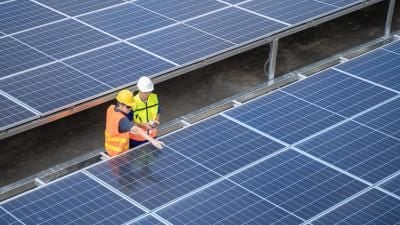
Two workers in safety gear inspecting solar panel installation on a large array.

Page author

This image shows a professional portrait photograph of a person in formal business attire, wearing a dark suit jacket, light blue striped shirt, and a patterned blue tie against a plain white background.

Elieser Tarigan , University of Surabaya

Elieser is a Professor of Electrical Engineering and Head of the Center for Environmental and Renewable Energy Studies at the University of Surabaya. He has served as a consultant and technical advisor for various national and international organizations including ADB, USAID, the Czech Ministry of Foreign Affairs, and provincial governments in Indonesia.

With Foundation funding, the University of Surabaya is building pathways for youth-driven climate action. In this blog, we hear from Elieser Tarigan about the work he is doing, with support from our small grants programme, to strengthen renewable energy literacy among university students. 

From awareness to action

What happens when young people are given not only knowledge about climate change, but also the trust and tools to act? At the University of Surabaya, Indonesia, we found the answer through a student-led initiative that transformed classrooms into living laboratories and students into advocates for a safer, more sustainable future.

With support from  Lloyd’s Register Foundation’s small grants programme, our project “Empowering D’Young Green: Renewable Energy for a Sustainable Future” set out to strengthen renewable energy literacy, practical skills, and leadership among university students. The result was more than a series of activities: it became a growing movement driven by youth.

Building capacity through education and practice

The project centred on D’Young Green (DYG), a student environmental group at Universitas Surabaya (UBAYA). This programme was designed to place students at the centre of learning, decision-making, and outreach. One of the first milestones of the project was the introduction of a new elective course on Renewable Energy within the Faculty of Engineering. Covering topics such as solar photovoltaic systems, wind and hydropower, geothermal energy, and socio-economic aspects of renewable energy, the course provided a strong technical foundation while encouraging systems thinking and real-world application. 

Learning extended far beyond the classroom. Students participated in hands-on projects, including the design of off-grid solar PV systems and small-scale wind energy prototypes. These practical experiences helped bridge the gap between theory and implementation—an essential step for building future engineers and sustainability leaders.

Learning from the real world

As part of the programme, students also had the opportunity to visit  the Benowo Waste-to-Energy Power Plant in Surabaya, one of the few facilities of its kind in Indonesia. Seeing how household waste is converted into electricity gave students a concrete understanding of how renewable energy solutions can address both energy security and growing sustainability challenges.

In addition, through collaboration with industry partner Utomo SolaRUV, DYG members helped deliver solar energy training for retired navy personnel preparing for post-retirement livelihoods. Designing modules, assembling solar kits, and leading training sessions allowed students to develop communication skills and confidence. 

Reaching beyond campus

With Foundation funding, we were able to expand engagement beyond the university. DYG members mentored high school interns, introducing them to data analysis and solar PV performance studies. Workshops for high school students combined renewable energy with Internet of Things (IoT) technology, demonstrating how smart systems can optimise clean energy generation.

One of the most widespread initiatives was a national TikTok competition organised to mark World Environment Day 2025. Under the theme “Beat Plastic Pollution”, students across Indonesia shared creative videos addressing plastic waste and environmental responsibility. The campaign reached more than 100,000 viewers, showing how digital platforms can amplify youth voices and environmental messages at scale.

Looking ahead: building pathways for youth-driven climate action

Funding from the Foundation’s small grants programme has played a catalytic role in supporting curriculum development, equipment procurement, training activities, and outreach. More importantly, it helped to create momentum. 

Today, D’Young Green is an officially recognised student organisation at UBAYA. The Renewable Energy course is embedded in the academic system, and in turn partnerships with industry and community groups continue to grow. What began as a one-year project now serves as a replicable model for youth-led renewable energy education.

As climate and energy challenges intensify across the world, initiatives like this remind us that solutions do not come from technology alone, but are driven by people, including young people, who are ready to accelerate real change.  

To learn more about our work, and to follow the activities of D’Young Green at Universitas Surabaya and the Center for Environmental and Renewable Energy Studies (PuSLET UBAYA), visit: http://puslet.ubaya.ac.id