Brits worry about climate change, want action, and back net zero. How do we know? Polling. Time and again.
The latest Lloyd’s Register Foundation World Risk Poll shows 80% of people in the UK consider climate change a ‘very or somewhat serious threat’. This chimes with the UK energy and net-zero department’s (DESNZ) own regular survey showing 77% of people very or fairly concerned about climate change. 68% in the same poll supported government action to tackle climate change, whilst Climate Barometer finds 63% support specifically for the UK’s net zero target.
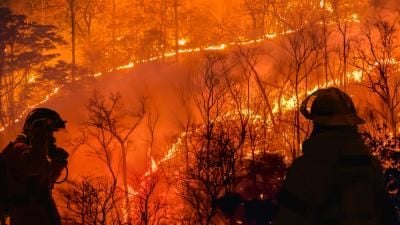
Climate and the environment feature in YouGov’s top concerns for British people. In 2021, when the UK hosted the UN climate summit, COP26, it was in the top three – as it was again in summer 2022, when we baked in 40°C. In recent weeks, it has risen again to third place as wildfires blaze, and the UK emerges from its fourth heatwave in three months. YouGov also shows most people joining the dots between heatwaves and climate change – across all age groups and almost all voting-intentions.
But despite this, people don’t necessarily realise that the majority share their concern. The World Risk Poll lays this bare: in high-income countries, there is a misalignment between people who see climate change as a threat, and those who think other people agree. The UK had the third biggest gap (38 percentage points, level with Italy, and behind Portugal and the US) between the 53% of people for whom climate change poses a ‘very serious threat’, and the 15% who thought most people in the UK would hold that view.
We know, as IPCC Chair Jim Skea puts it, that “it’s chemistry and physics that if you want to stop global warming, you have to achieve net zero emissions, and that isn’t a political choice.” It is the only solution to stop ever worsening climate change. Yet we find ourselves in a political moment where some seek to divorce these concepts – with a degree of success in parts of the British media – to demonise net zero as expensive, quasi-religious zealotry, without having actually to deny climate change. In other words, to undermine the policy solution without having to do more than create misperception about what it means.
A similar risk has emerged in reporting of heatwaves. ECIU analysis shows 72% of national newspaper articles referring to May and June extreme heat included no reference to climate change. This is of a piece with all-too-familiar ‘fun in the sun’ coverage – kids playing in fountains, families on beaches, and queues at ice cream vans. That’s not to say people aren’t allowed to enjoy the weather; some people chase tornadoes, after all. But it risks adding to misperceptions, and misses the mark of underlining that extreme heat kills – 2,877 people, to be precise, during May and June UK heatwaves; more than 1,100 of which can be directly attributed to additional heat from human-caused climate change.
Where it starts to translate into policy is in what reaches politicians. In 2020, Professor Rebecca Willis wrote about her work with MPs and their fear of raising climate change issues in the absence of hearing from their constituents. More recently, ECIU work with YouGov and Climate Barometer flagged confusion amongst MPs – in this Parliament – about net zero. First and foremost, only two thirds understood that it is essential to halting climate change. But echoing Willis’ work, MPs wrongly thought their constituents more likely to oppose, rather than support, onshore wind and solar. In fact, Climate Barometer showed 69% and 73% and DESNZ showed 73% and 84% support respectively. Whilst that falls amongst Reform voters, at the local elections, more (43%) said they would prefer solar in their local area, than Reform’s policy of fracking (23%).
The misperception gap leaves us with a ‘silent majority’ problem. Those most vocal in opposing net zero secure a large share of the debate by driving the perception that they do so on behalf of a majority. The coverage and op-eds read to some politicians as though that majority is warming to an anti-net zero message – and the evidence of their postbags doesn’t correct this error. Thus, those making decisions about political strategy and policy are left doing so with a general sense that action to tackle climate change is far more contested than it is. But the views of the silent majority are missing.
The Labour government was elected on a pledge to do more on climate change. And, to be fair, they have. But even as Andy Burnham took office as PM – a man who just last year supported a ‘fossil fuel non-proliferation treaty’, and urged no turning away from net zero, which he characterised as an opportunity for communities and businesses – commentators and political-strategy-watchers talked of row-backs and compromises.
Without the actual silent majority speaking up about their climate change concerns, the misperception gap danger is that decisions are made on the wrong data – ‘evidence’ from op-eds rather than the public. So the job ahead for everyone who works to communicate on climate change, everywhere and at every level, is to ensure these perception gaps don’t grow. It’s important people can access and understand facts – including facts about what other people think.