Nature and people positive: a bold new vision for the ports ecosystem

This page is approximately a 5 minute read

This page was published on

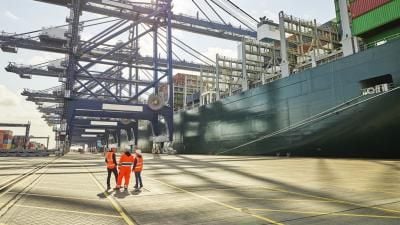
Port workers in safety gear observing massive container ship being loaded by large cranes.

Page author

Ruth Boumphrey, Chief Executive, Lloyd's Register Foundation

Ruth Boumphrey, Chief Executive, Lloyd's Register Foundation

Page author

A professional in a navy suit with white shirt smiling outdoors, wearing a circular blue-green lapel pin.

Alfredo Giron, Head of Ocean at the World Economic Forum

In this blog, Lloyd's Register Foundation's Chief Executive, Ruth Boumphrey, and Alfredo Giron, Head of Ocean at the World Economic Forum, establish a bold new vision for a nature and people-positive port ecosystem that can support environmental regeneration while strengthening the financial and social resilience of ports, workers and local communities. 

Overview

Climate change is having an unprecedented impact on our infrastructure systems and ports are on the frontline of this battle.

While contributing 2.6% of global gross domestic product and 80% of global trade, 86% of ports face exposure to more than three natural hazards, such as coastal flooding, storms, heatwaves or rising sea levels. Without major intervention, a 40 centimetre rise in sea levels could submerge some of the world’s busiest ports, including Houston (United States), Shanghai (China) and Lazaro Cardenas (Mexico).

Climate-related port disruptions already cost the global economy $7-10 billion annually. Without adaptation, this could rise to $25–30 billion by 2050, with cascading effects across global supply chains amplifying these losses three-to five-fold.

What are nature and people positive ports?

A nature-positive port ecosystem works with nature rather than against it, designing and operating port areas to reduce harm, restore ecosystems and promote resilience. This means using clean energy and sustainable materials, cutting pollution, limiting invasive species and embedding circular economy principles into operations and planning.

By doing so, ports can regenerate coastal habitats, attract green finance and strengthen their long-term competitiveness.

A people-positive port ecosystem puts workers and communities at the heart of maritime transformation. It focuses on safety, skills and inclusion to create future-ready, attractive jobs and ensure fair participation in decision-making.

By fostering wellbeing and local opportunity, ports earn social licence to operate and ensure that environmental progress translates into real benefits for people. Building on this momentum, ports can take it further by embedding positive principles for nature and people into every aspect of their design and operation.

Why collaboration is key

Ports rely on a complex system of public and private cooperation, given their close links with infrastructure, energy, food, land and ocean use. We are calling on port actors to build a common vision and collaborate to build true resilience – supporting ecosystems and regeneration while strengthening the communities that depend on ports.

As ports adapt to the new realities of a changing climate and evolving global trading patterns, and as new port systems are designed and built, nature and people must be at the heart of this transformation.

This means thinking of them as catalysts for economic prosperity, where economic activity restores ecosystems and uplifts workers and communities. Ports can actively restore nature, reduce emissions and champion circular technologies.

By investing in safety, skills and community inclusion, they enhance their social licence to operate. By committing to nature and people positive strategies, it’s estimated that ports can generate $54 billion in annual business opportunities by 2030.

Through practices such as enhancing clean energy, sustainable materials and advanced operating systems, decarbonization of ports and shipping could support 13.3 million additional jobs before 2050.

Port of Rotterdam, Netherlands

The Port of Rotterdam is a global pioneer in publishing a comprehensive Nature Vision, redefining ecological leadership in maritime infrastructure. In partnership with the Naturalis Biodiversity Centre, the port aims to become net positive – restoring nature while supporting sustainable growth within the Port and extending to the Rhine-Maas delta.

Covering 25 kilometres (km) on land and 60 km at sea, the framework integrates ecological restoration initiatives ranging from tidal and dune recovery to oyster reef pilot projects. Aligned with the global goal of protecting and restoring 30% of degraded ecosystems by 2030, Rotterdam sets a benchmark for regenerative, nature-positive ports.

Port of Antwerp, Belgium

The Port of Antwerp is transforming one of Europe’s largest industrial hubs into a living ecological network. Through its Ecological Infrastructure project, the port manages and conserves more than 90 protected species of flora and fauna by creating new green areas connected through “green corridors” that enable spawning and habitat regeneration.

Spanning 650,000 square metres, the initiative has improved water quality, expanded biodiversity, and opened new recreational spaces, thereby strengthening the relationship between the port and its surrounding communities.

Porto do Açu, Brazil

Covering 4,000 hectares – half of its operational area – the Port of Açu has transformed the Caruara Reserve into a catalyst for ecological restoration and social renewal. Once a critically endangered ecosystem of mangroves, grasslands, swamps and lagoons, the reserve now protects 880 plant and animal species, including 22 threatened ones.

Beyond conservation, Açu empowers the local community through education and opportunity, hosting over 45 research projects integrated into 60 local schools and creating new livelihoods for women through nature-based initiatives.

The nature and people’s positive ports programme

It brings together port authorities, industry leaders, scientists, financiers and local communities to accelerate the transition toward ports that regenerate nature and benefit people.

Over the next year, the programme will bring together a global community of port leaders, innovators and policymakers to define what it means to be a “nature and people positive port” and to embed these principles into business strategy.

Through a series of targeted activities and collaborations, it will foster knowledge exchange, promote local engagement and highlight practical examples of ports delivering measurable ecological and social benefits.

Many ports are already making nature and people positive interventions to great effect.

Making a nature and people positive port sector

Delivering this transition will hinge on seizing opportunities in high-growth regions such as Africa, Southeast Asia, Latin America and China. With 75% of 2050’s infrastructure yet to be built, integrating green design and nature-based solutions into new developments offers enormous potential for impact.

This is not just an environmental imperative, but also an economic and social opportunity.

By working together across innovation, finance, and policy, we can build ports that protect nature, empower people and drive a more sustainable global economy.