Warned but not ready as a third of people alerted to disasters can't act on them, global poll finds
This page is approximately a 7 minute read
This page was published on
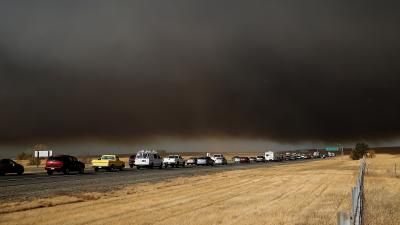
Fewer than half of warned adults in low- and lower-middle-income countries could act, compared with 71% in high-income countries.
Having a household disaster plan and a sense of personal agency is linked to a jump in action from 27% to 83%.
Societal resilience reaches a record 66 out of 100, while individual resilience falls to its lowest ever recorded level on the World Risk Poll Resilience Index.
Published on International Day for Disaster Risk Reduction, the research points to the need for multi-channel alerts and investment in household preparedness, as nearly 220 million adults impacted by a disaster in the past five years received no warning despite 77% of them owning a mobile phone.
From alert to agency
More than a third of people who received a disaster warning were unable to act before it struck, according to new global research from Lloyd’s Register Foundation.
The gap between being warned and being able to respond is widest in low-income countries, where people are also the most likely to be affected by a disaster. One in five adults, an estimated 1.1 billion people, has been impacted by a disaster in the past five years but almost 220 million of them received no warning at all.
The new World Risk Poll report, From alert to agency: What turns warnings into action?, draws on more than 143,000 interviews conducted by Gallup across 140 countries and territories in 2025. Adults affected by a disaster were asked about the event that had impacted them most during the previous five years, whether they received warnings and if they were able to act. It’s published alongside the companion reports, A resilient life: How wellbeing shapes the capacity to cope, which tracks the Poll's Resilience Index, and After the storm: How disasters reshape resilience and trust.
The research comes as countries work towards the UN's goal of protecting everyone through early warning systems (EWS) by the end of 2027. From Nepal's deadly August floods to the wildfires that devastated parts of Europe, recent disasters have tested how well countries can get people to safety.
Topline findings include:
- Adults in low-income countries are almost twice as likely to be affected by a disaster as those in high-income countries (31% vs. 16%), but less likely to be warned (64% vs. 84%).
- In Central and Western Africa, fewer than half of affected adults (47%) received any advance warning at all.
- More than three quarters (77%) of disaster-affected adults who received no warning own a mobile phone, equivalent to more than 170 million adults worldwide - representing a significant opportunity to expand warning coverage.
- Receiving warnings through a range of channels (like SMS, social media and TV warnings) was especially effective in getting people to respond: one warning channel got 37% of people to act, two got 51%, three got 64% - with smaller increases for channels beyond three.
Nancy Hey OBE, Director of Evidence and Insight at the Lloyd’s Register Foundation Global Safety Evidence Centre, said:
“Four in five people affected by a disaster now receive warnings before it strikes. That's real progress. But a warning is only as good as what people are able to do with it. We’re seeing that those with a household disaster plan and confidence they can protect themselves and their families are much more likely to take action - showing that resilience really does start at home. Warnings can save lives when people are ready and supported to act on them; we need to invest in building that readiness; locally, nationally and internationally.
“The data shows there is still a global gap to be closed when it comes to resilience and access to life-saving early warnings. But this isn’t just an issue for lower income countries; among people with the lowest wellbeing, those in higher income countries are similarly vulnerable.”
The companion report, A resilient life, also finds that:
- Societal resilience, driven by trust in national institutions, rose from 63 in 2021 to 66 in 2025. Individual resilience fell from 46 to 42, led by declining personal agency in India, Pakistan and Indonesia.
- High-income countries score lowest of any income group on societal resilience - the opposite trend to other elements of the Index. The US ranks 2nd of 139 on individual and household resilience, but 130th on societal. Greece (-11), New Zealand (-8), Australia, France and the Netherlands (all -6) saw significant societal resilience drops since 2021.
- Resilience is rising faster in Africa than anywhere else. North Africa (+5), Southern Africa (+4), Central/Western and Eastern Africa (+3 each) led regional gains since 2023, driven by a variable mix of rising internet access, household planning and financial resilience in countries including Algeria, Nigeria, Kenya, Egypt and Uganda.
- National wealth offers no "trickle-down" protection: across all regions, people with low wellbeing in high-income countries are as low in resilience as those in poorer nations. Nearly three in 10 people (29%) feel their government doesn't care about them at all, rising to nearly half in both low-income (44%) and high-income (45%) countries.
Dr Andrew Tupper, Chief of the Early Warning Services Section at the World Meteorological Organization, said:
“An early warning system is useless if it doesn’t empower people to act, and that’s why the Early Warnings For All effort emphasises end-to-end systems. Understanding and preparing for what might come. Investing in the observations and the science to be able to predict what’s coming. Having multiple channels of communication to get the warnings all the way into the home, including to the most vulnerable. And the most important of all – ensuring that everybody can respond. The good news is that these things are possible and achievable. The World Risk Poll challenges us that there is still much work to do despite our advances, but it also reminds us that we can achieve enormous outcomes for our communities by working together on early warnings.
“The report also reminds us that there is no country in the world that has it all perfectly sorted out. We are all in this together and we can all learn from each other, whether we are in a poor or a wealthy country.”
Dr. Cosmas Luckyson Zavazava, Director, Telecommunication Development Bureau, International Telecommunication Union (UN Assistant Secretary-General), said:
“The fact that nearly four out of five people who do not receive a warning owned a mobile phone highlights a major opportunity to reach those most at risk. It is key for Governments to accelerate the implementation of Cell Broadcast, which enables authorized authorities to send location-specific emergency alerts directly to mobile phones within seconds. This requires no app and no registration, and covers residents, visitors and people moving through an affected area. By making better use of existing mobile networks, we can turn them into lifelines that help ensure no one is left behind when disaster strikes.”
Loretta Hieber Girardet, Chief of the Risk Knowledge, Monitoring and Capacity-Development Branch of the United Nations Office for Disaster Risk Reduction, said:
“An early warning system is not just technology or an alert on a phone, but a chain that starts with understanding who is most at risk and ends with people being able to act. These findings remind us that resilience may start at home, but households cannot build it alone. Whether people can protect themselves depends on the investments and decisions made long before a disaster strikes – from understanding risk and reducing vulnerability to ensuring that preparedness reaches those most exposed. Early Warnings for All must remain a political priority, backed by predictable, long-term financing so that that everyone, wherever they live and whatever their circumstances, has the capacity to act when a warning comes.”
Caroline Zastiral, Acting Global Lead, Disaster Risk Reduction and Resilience of the International Federation of Red Cross and Red Crescent Societies said:
"As the World Risk Poll shows, preparedness and a sense of agency enable early action. In Nepal, a school principal drew on Red Cross preparedness training to evacuate around 900 students minutes before the August flash flood destroyed the school. In Malawi, volunteers mobilised communities to clear storm drains ahead of extreme rainfall in January. In 2025, anticipatory action supported 9.6 million people in 54 countries to act before disaster struck. Warnings lead to action when people have the trust, knowledge, time and resources to protect themselves, their loved ones and their assets.
But a huge gap remains, especially in low-income countries, where many people could not act on the warnings they received. The emerging Treaty on the Protection of Persons in the Event of Disasters would be an important step towards making disaster risk reduction a legal duty of States, strengthening preparedness and the allocation of domestic and international resources when forecasts show a disaster is coming, not only after it has struck. Collaboration and investment across the whole Early Warnings for All system must continue, so that everyone, everywhere can act on impact-based forecasts."