Muntasir has a background in Engineering and Materials Science, with extensive experience leading R&D and product development across hardware, software, and semiconductors.
In partnership with the National Technical University of Athens.
This page is approximately a 3 minute read
This page was published on
This project's duration was 5 years
£950,000
AEGIS is led by the National Technical University of Athens (NTUA) and supported by the Institute of Electrical and Electronic Engineers (IEEE), the Institute of Marine Engineering Science and Technology (IMarEST), and the Association of Materials Protection and Performance (AMPP).
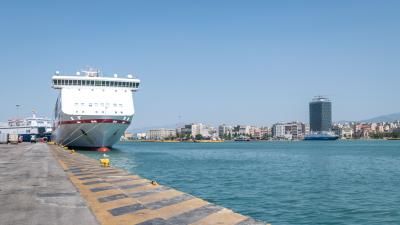
Led by the National Technical University of Athens (NTUA) and funded by Lloyd’s Register Foundation, the AEGIS programme aims to support and widen the safe adoption of Onshore Power Supply (OPS), the practice in the maritime industry that allows a docked ship to draw power from environmentally sustainable shore-based systems, rather than use its own diesel engines.
AEGIS is delivered through a collaboration of NTUA schools, the School of Naval Architecture and Marine Engineering (lead school), the School of Chemical Engineering, and the School of Electrical and Computer Engineering, bringing together interdisciplinary expertise. This academic base is matched with international cooperation with leading professional and standardisation bodies: AMPP (the Association for Materials Protection and Performance), IEEE (the Institute of Electrical and Electronics Engineers), and IMarEST (the Institute of Marine Engineering, Science and Technology).
This strategic project establishes a comprehensive research and validation framework to address the technical challenges that arise when ships are connected to Onshore Power Supply systems at berth. It focuses on advancing corrosion prevention and ensuring the long-term structural integrity of maritime assets, while further solidifying the high electrical safety standards already associated with shore-side connections. The AEGIS programme disseminates its research findings to key decision-makers across the maritime value chain, supporting the confident and widescale deployment of OPS worldwide.
Key activities for the programme include:
By creating an enabling environment to support the widespread adoption of Onshore Power Supply (OPS) practices, the AEGIS programme aims to reduce air pollution and greenhouse gases in port areas, decrease reliance on fossil fuels, and support port ecosystems as drivers of a more sustainable maritime economy. The programme’s capacity-building activities will ensure that the global maritime workforce is fully prepared to manage the infrastructure of the future, safeguarding both human life and high-value maritime assets.
If you would like to learn more about the Nature and People Positive Ports programme, subscribe to our newsletter or contact our programme manager using the details below.
Widespread adoption of Onshore Power Supply (OPS) at ports worldwide has the potential to significantly contribute to safer conditions for workers and locals, as well as accelerating the decarbonisation of the maritime industry, but the unresolved problem of corrosion is a barrier. The AEGIS project addresses this critical challenge by developing and sharing robust mitigation technologies that will make it easier and safer for the industry to adopt cold ironing.”
Professor John Prousalidis AEGIS’ Scientific Responsible
The global adoption of sustainable shore power is set to overcome one of its least addressed technical challenges following the launch of the newly inaugurated AEGIS (Advanced Protection for MaritimE Infrastructure and Globally Sustainable Shore Power) project, funded by Lloyd’s Register Foundation.
Discovering Safety joins forces with Safetytech Accelerator to build a Smarter Regulation Sandbox.
With funding from Lloyd's Register Foundation, Moi University has launched a groundbreaking new project to advance skills training for safer engineering.