
Valuing Global Safety: building a value-for-money framework

This page is approximately a 4 minute read

This page was published on

Safety resources are limited, and every decision to fund an intervention involves trade-offs. The Global Safety Value Bank, developed by Mission Economics in collaboration with Lloyd's Register Foundation's Global Safety Evidence Centre, is a practical tool designed to help decision-makers compare the value of safety interventions in a consistent and transparent way.

Underpinned by three Topic Notes, it provides a framework for applying economic evidence to safety decisions globally — covering valuation methods, health and wellbeing approaches, and the challenges of applying these values across different countries and contexts.

Download the Valuing Global Safety Topic Notes

The quick read

The Global Safety Value Bank brings together monetary values for safety outcomes to support value-for-money decision-making, and helps users assess safety interventions in a consistent, transparent and proportionate way. Decision makers are supported to compare different types of safety benefit, from lives saved to wellbeing improved, and apply economic evidence in real-world decisions. It provides a shared starting point for understanding value, improving comparability, and making trade-offs explicit. 

These topic notes are the intellectual foundation of the Global Safety Value Bank, each of which explore how to measure and value global safety. Commissioned and published by Lloyd's Register Foundation's Global Safety Evidence Centre, the series sets out a framework for using economic evidence to support decisions about safety interventions - before funding is committed, through appraisal, and after implementation, through evaluation.  

Topic Note 1: Building the Framework

This note sets out the overall framework for using monetary valuation in safety appraisal, the Value for Money framework. It focuses on how to identify credible values for safety outcomes and express them, where appropriate, in monetary-equivalent terms. These values can support social cost-benefit analysis, cost effectiveness analysis and lighter-touch approaches such as breakeven or scenario analysis. The aim is not to reduce safety to pounds and pence, but to make trade-offs more transparent. 

Topic Note 2: Health and Wellbeing Approaches

This compares and examines two approaches to valuing safety outcomes, drawn from health and wellbeing approaches. Health economics and wellbeing economics are not rivals; rather they answer different parts of the same question: what does safety make possible for people? A framework for global safety valuation should therefore draw on both. This note explains the main metrics used in each approach, considers their strengths and limitations for safety valuation, and sets out practical guidance to support their use. 

Topic Note 3: Equity, Transferability and Global Application

In this note the question of whether and how safety values examined in Topic Note 1 and 2 can be transferred and applied across countries is considered. This matters because many of the values currently available for safety appraisal are derived from evidence in the UK and other high-income countries. Since Lloyd's Register Foundation works globally, we need to consider whether a value derived in one country may be useful in another. Three questions are addressed. First, how far can values travel? Second, how can values be adjusted when they cross borders, to reflect local conditions? Third, when does value transfer create issues, particularly around fairness?
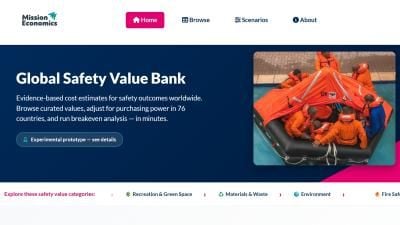
The Global Safety Value Bank

An experimental prototype, intended to explore evidence-based cost estimates for safety outcomes worldwide.

Explore
Screenshot of the Global Safety Value Bank Scenario Generator webpage, featuring two workers in hard hats.

Download Topic Note 1

Valuing Global Safety Topic Note 1: Building the Framework

This is the first in a series of three topic notes exploring how to measure and value global safety.

Download Valuing Global Safety Topic Note 1: Building the Framework (PDF, 423.72KB)

Citation

If you wish to use and reference the Valuing Global Safety: Building the Framework Topic Note 1, please include the following DOI: https://doi.org/10.60743/3MJ2-CY35 

Example Citation in IEEE Style:

Lloyd's Register Foundation, A. Little, S. MacLennan, and Mission Economics, “Valuing Global Safety: Building the Framework. Topic Note 1,” Lloyd's Register Foundation, 2026, doi: 10.60743/3MJ2-CY35. 

Download Topic Note 2

Valuing Global Safety Topic Note 2: Health and Wellbeing Approaches

This is the second in a series of three topic notes examining how to measure and value global safety within a value for money framework.

Download Valuing Global Safety Topic Note 2: Health and Wellbeing Approaches (PDF, 410.90KB)

Citation

If you wish to use and reference the Valuing Global Safety: Health and Wellbeing Approaches Topic Note 2, please include the following DOI: https://doi.org/10.60743/V6AJ-1105

Example Citation in IEEE Style:

Lloyd's Register Foundation, A. Little, S. MacLennan, and Mission Economics, “Valuing Global Safety: Health and Wellbeing Approaches . Topic Note 2 ,” Lloyd's Register Foundation, 2026, doi: 10.60743/V6AJ-1105.

Download Topic Note 3

Valuing Global Safety Topic Note 3: Equity Transferability and Global Application

This is the third in a series of three topic notes examining how to measure and value global safety within a value for money framework.

Download Valuing Global Safety Topic Note 3: Equity Transferability and Global Application (PDF, 401.60KB)

Citation

If you wish to use and reference the Valuing Global Safety: Equity, Transferability and Global Application Topic Note 3, please include the following DOI: https://doi.org/10.60743/BEFP-ZE57

Example Citation in IEEE Style:

Lloyd's Register Foundation, A. Little, S. MacLennan, and Mission Economics, “Valuing Global Safety: Equity, Transferability and Global Application. Topic Note 3,” Lloyd's Register Foundation, 2026, doi: 10.60743/BEFP-ZE57.

More on our work with Mission Economics

businessman signing documents

A practical framework for value-driven grant-making

This framework provides our prospective grant applicants, partners and other funders with a practical, accessible approach to impactful, evidence-based grant-making that does not require a PhD in economics or evaluation science.

Tools and methods