For Brad Geyser, sea rescue has always had one simple purpose: responding when people need help.
He joined South Africa’s National Sea Rescue Institute in 1975 as a volunteer and training crew member at Bakoven, on the Cape Town coast. Over the decades, he became a coxswain, a station commander and later an Honorary Life Governor of NSRI. He helped shape training, supported generations of volunteers and responded to emergencies that stayed with him long after the boats returned to shore.
“Open water has always carried risk, not just for the community but for us, the sea rescue people,” Brad says. “Over time, those risks have evolved. The risks are challenging, but we have to change with them.”
That change is now happening faster. Rising sea levels, stronger storms and shifting weather patterns are reshaping the risks faced by coastal and inland communities. Flooding in South Africa is becoming more frequent, more severe and harder to predict.
NSRI is a volunteer-led organisation that works to save lives on South African waters. Many people know it for rescues at sea, but its work stretches far beyond the coastline. In South Africa, 95% of drownings occur inland. Drowning is also the country’s second leading cause of accidental death.
That reality became painfully clear in April 2022, when record-breaking rains hit KwaZulu-Natal. Floodwater swept through communities around Durban, washing away infrastructure, homes, land and livelihoods. In just a few days, 435 people lost their lives, 80 were reported missing, and more than 128,000 people were affected.
Brad remembers the speed and force of it.
“It was an unexpected flash flood after a lot of rain, days of rain, and roads became rivers,” he says.
Brad has served for over 50 years. He has been first on scene at overturned boats, casualties at sea, people in the water and incidents that placed rescuers under intense pressure. Those experiences taught him how much depends on preparation.
“You learn very quickly how important preparation, training and teamwork are to a successful outcome,” he says.
That principle matters more as risks become less predictable. Rescue teams will face stronger storms, dangerous floodwater, damaged infrastructure, unfamiliar rescue scenarios and longer operational demands. The people who step forward need training, equipment, shared knowledge and systems that help them operate safely.
This is where NSRI’s connection to the International Maritime Rescue Federation (IMRF) becomes important. IMRF is a global network of maritime search and rescue organisations, bringing rescue teams together to share expertise and strengthen capability across countries.
Through its FutureSAR initiative, funded by Lloyd’s Register Foundation, IMRF is helping the global search and rescue community understand how climate change is affecting its work.
FutureSAR identifies the key challenges that maritime SAR organisations are likely to face as climate impacts increase, and develops guidance, practical tools and best practices to support future rescue operations.
For organisations such as NSRI, this kind of collaboration creates a bridge between local experience and global learning. South Africa’s experience of inland flooding, drowning prevention and volunteer-led rescue can inform a wider understanding of climate-related risk. At the same time, lessons from other countries can help NSRI prepare for new scenarios at home.
Lloyd’s Register Foundation’s role is to support that exchange of knowledge. Through its funding of IMRF’s FutureSAR initiative, the Foundation is helping rescue organisations around the world assess climate risks, plan adaptation and share learning. The goal is to respond to disasters more effectively, while making search and rescue work safer and more resilient as conditions change.
For Brad, that shift is essential.
“Rescue alone is no longer enough,” he says. “We have to prevent it.”
In practice, prevention means teaching people to swim, helping children understand how to survive in water, offering resuscitation training in schools, working with communities and preparing before climate disasters strike. It means seeing safety as something built long before a rescue call comes in.
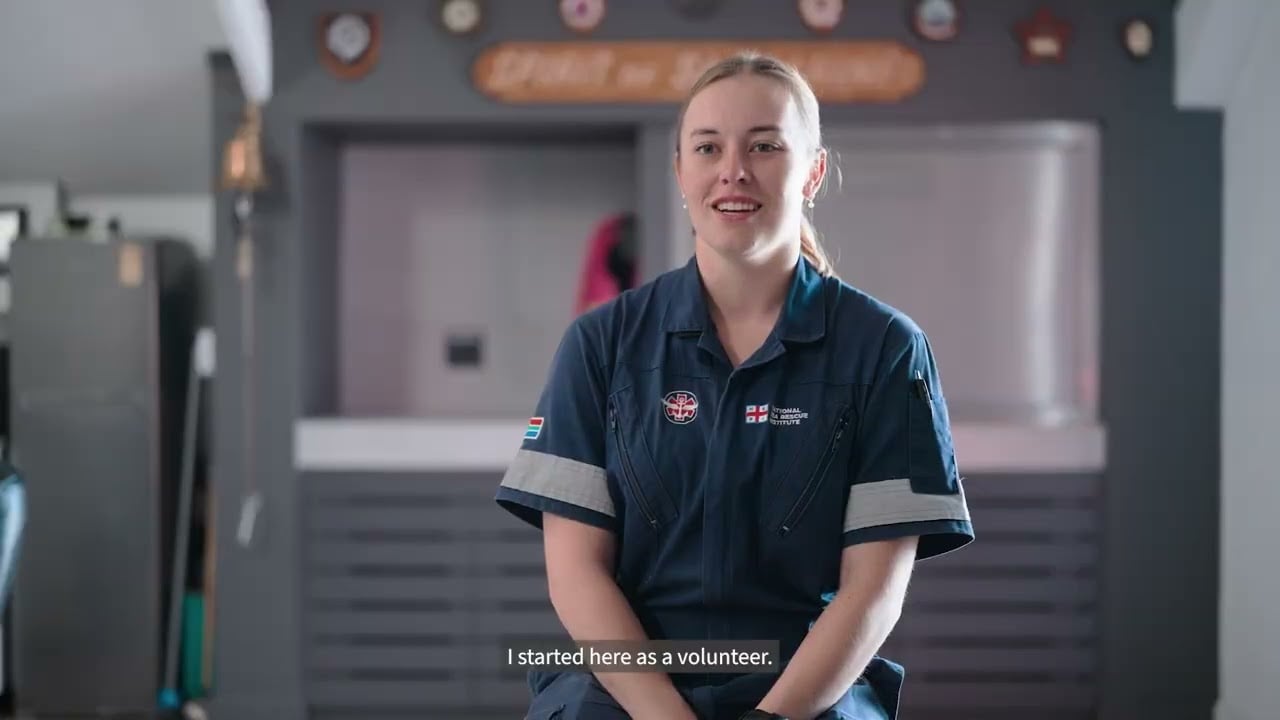
For volunteers on the water, training remains the foundation. Roxy Traylor, an NSRI coxswain, started as a trainee.
“The ocean has always been a large part of my life,” she says. “The sea can be beautiful and it can be dangerous, but that’s why we’re here. We’re here to make it safer.”
“Starting as a trainee,” she continues, “you have a lot of guidance and knowledge being passed down from people like Brad, that older generation that has been here for a while and they’re happy to pass on their knowledge.”
For many NSRI volunteers, the motivation remains deeply human.
“Saving a life is what motivates us to do what we do,” Roxy says.
Bevan Geyser, Brad’s son and now an NSRI rescue volunteer himself, puts it simply: “The greatest gift you can give somebody is their life. The ability to save somebody and bring them back to their loved ones, I think, is the greatest gift you can ever give anyone.”
For Brad, looking back over half a century with NSRI, the meaning of the work remains tangible.
“NSRI has been an incredible experience,” he says. “And the fact that there was something really tangible that came out of this: saving people’s lives.”
The future of search and rescue will depend on the next generation of rescuers. It will also depend on the systems around them: training, prevention, international collaboration and practical tools that help them prepare for risks that are still evolving.
In South Africa, volunteers continue to respond when people need help. Through NSRI, IMRF’s FutureSAR initiative, and Lloyd’s Register Foundation’s support, their experience is also helping to shape a wider response to climate change, one built around shared knowledge, safer crews, and lives saved.