Practical Action is supporting Indigenous women in Bolivia to reshape disaster risk reduction
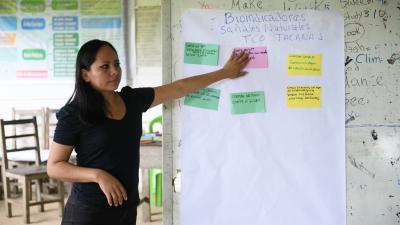
As climate risks intensify in Bolivia, Indigenous knowledge is providing vital evidence to help communities prepare, adapt and stay safe. Through Practical Action’s work with Tacana communities, women like Delmira are helping turn local knowledge into stronger disaster-risk planning.
Watch now
Turning knowledge into climate action
In the Tacana Indigenous Territory in northern Bolivia, signs of risk are seen in the river, in the movement of birds, in the dryness of the forest, and in the anxious calculations families make when crops begin to fail.
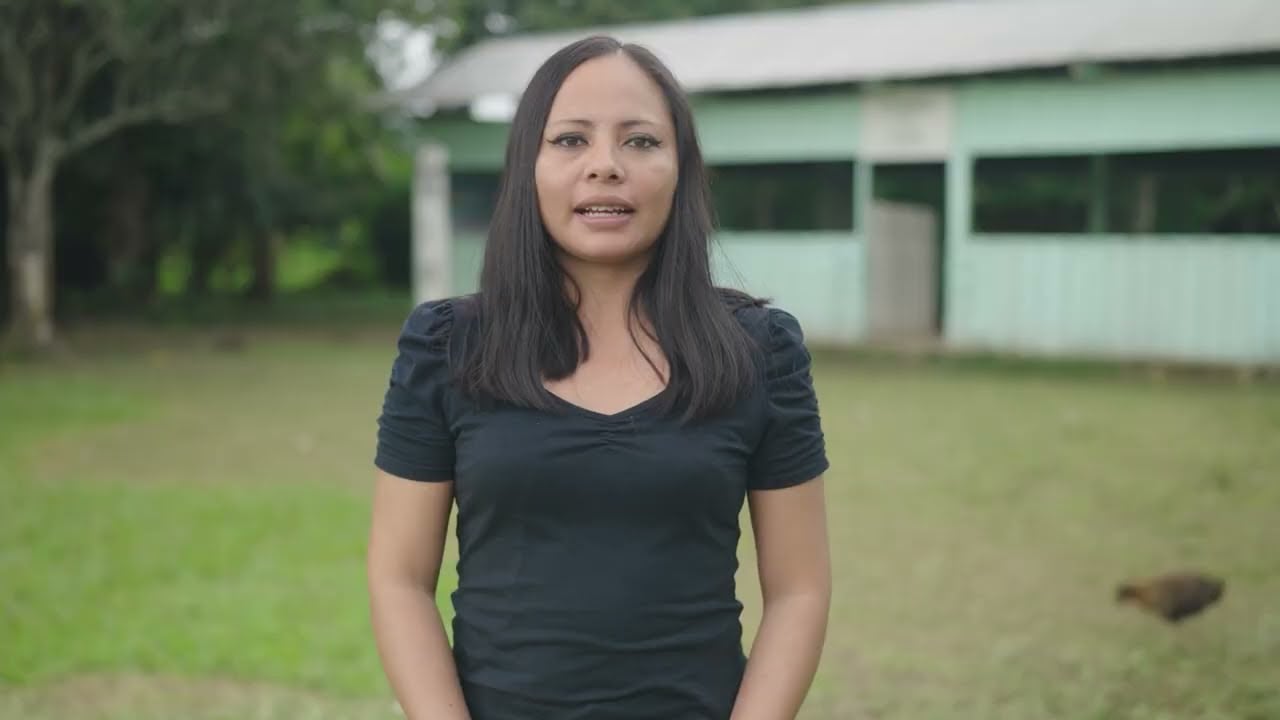
For Delmira Mamio Serato, a Tacana woman and community leader, climate change disrupts daily life. Drought dries crops before they are ready to harvest. Wildfires damage the forest that sustains local communities. Floods rise quickly, entering homes, cutting off roads and threatening the fragile stability that families work hard to build. These ‘multihazards’ compound over time and are happening more frequently.
“Climate change disrupts our plans, our food, our sense of security,” Delmira says. “It makes it harder to live our lives in dignity and thrive.”
Her words reflect a reality felt across Bolivia. According to the 2024 Lloyd’s Register Foundation World Risk Poll, 79% of people in Bolivia believe climate change is a serious threat to people in their country. Across Latin America and the Caribbean, 80% of people say they are worried about experiencing serious harm from severe weather. The region also has the second-highest rate worldwide of people who have personally experienced, or know someone who has experienced, serious harm from severe weather in the past two years.
In Bolivia, where 36 Indigenous nations are officially recognised,1 it means that half of the population has historically been left out of the data and information used to shape disaster management plans. When voices are missing, so is evidence. When evidence is incomplete, safety systems are weaker.
Delmira’s story shows a different approach. “We are not just observers or victims of these disasters,” she says. “We are the first to feel them coming.”
Practical Action, a global development charity, is working with the Tacana women’s Indigenous council, CIMTA, and the Tacana Indigenous council, CIPTA, to strengthen local disaster-risk management and climate adaptation.
The project supports a much-needed shift: women and Indigenous communities are now being recognised as people with evidence, insight and leadership to offer.
Through its Global Safety Evidence Centre, Lloyd’s Register Foundation provides data and funding to support Practical Action’s work as part of the global Zurich Climate Resilience Alliance. The aim is to help turn evidence into action, reducing vulnerability for 20,000 people in areas already facing increasingly severe climate impacts.
“Effective disaster-risk reduction depends on gathering different types of data,” says Federico, the Amazonia Office Coordinator for Practical Action. This includes “scientific models and technical expertise, as well as Indigenous knowledge.”
Practical Action’s work includes strengthening early warning systems so that information reaches families clearly and promptly. The approach uses accessible tools such as radio, primers, flipcharts and posters, alongside alternative education methodologies that support community learning. These materials help translate risk information into something people can use before floods, fires or droughts become crises.
For Delmira, this work is also deeply personal. She grew up in a family where leadership was part of life. Her parents were Indigenous leaders, and through them she learned the responsibilities that come with belonging to a community and a territory.
“My parents were Indigenous leaders. I grew up with that leadership,” she says. “I learnt a lot from them.”
Delmira left her community to study elsewhere, then returned with the intention of contributing what she had learned. “I left my community to pursue my studies in other places, returned with that knowledge, so I could also contribute to my community in some way,” she says.
That commitment led her to join the Women Who Teach initiative, which encourages women to take an active role in disaster risk management and decision-making spaces. The name itself carries a quiet confidence. Women are learning and teaching. They are sharing knowledge, building trust and helping others see that safety is a shared responsibility.
“With the support of Practical Action, we are strengthening the technical understanding of risk, combining it with ancestral knowledge,” Delmira says.
This is one of the most important lessons from the Tacana experience. Disaster risk reduction is often described in terms of systems, infrastructure and planning. All of those are necessary. But safety is also built through relationships. It depends on whose knowledge is respected, who is invited into the room, and who feels able to act when danger approaches.
Globally, only 52% of people say they feel they can do anything to protect themselves or their families in the event of a disaster.2 That gap between awareness and agency is crucial. People may understand that climate risks are growing, but without trusted information, practical tools and a voice in decision-making, awareness can become anxiety rather than action.
The work in the Tacana Indigenous Territory shows that people are better able to protect themselves when they are treated as partners in safety, not passive recipients of help.
It also shows why women’s leadership matters. In many communities, women are deeply involved in caring for families, managing food and water, sustaining livelihoods and passing knowledge between generations. When their experience is excluded, disaster planning misses part of the picture. When their leadership is supported, the response becomes more rooted, more trusted and more likely to last.
“When Indigenous voices and women’s voices are heard, the action becomes stronger and more effective,” Delmira says.
Her dream is to create opportunities rooted in resilience. She wants livelihoods built around the strengths of each community and each woman.
“Ultimately, I want people to live with dignity in our territory,” Delmira says. “To return home. To work close to family. To build community businesses and strengthen our skills.”
For Delmira, the key to this is being able to plan, to belong, to make choices, to pass something stronger to the next generation.
“If we get this right,” she continues, “then our daughters will grow up knowing they can lead and protect us, for generations to come.”
Climate change disrupts our plans, our food, our sense of security. It makes it harder to live our lives in dignity and thrive.
Delmira Mamio Serato Tacana Community Leader
Building safer, resilient communities


