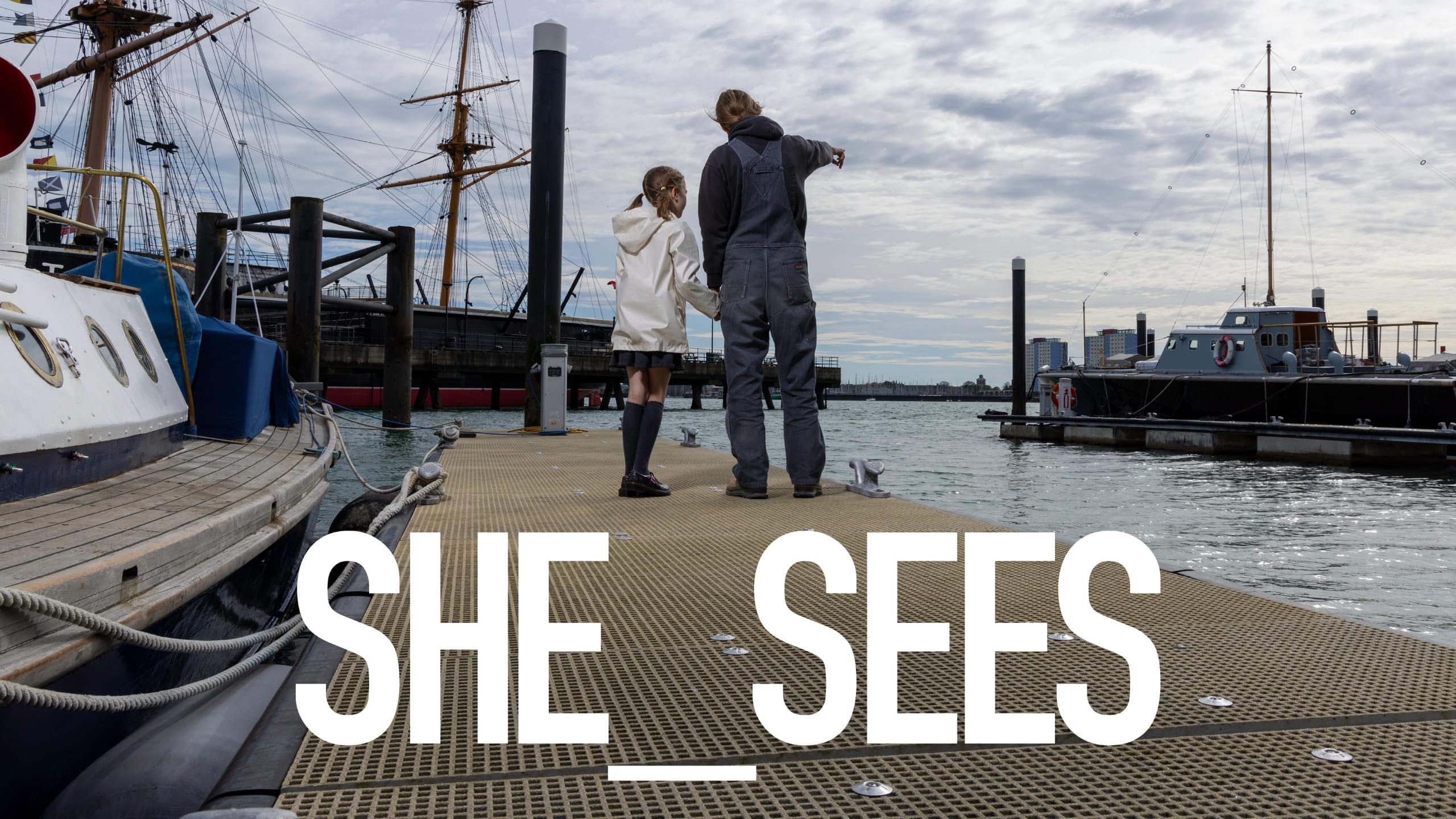
Inside Boathouse 4 at Portsmouth Historic Quarter, the SHE_SEES exhibition unfolds in a space where maritime history and present-day work meet.
For Charlotte, a communications adviser at KBS Maritime, that setting is part of the power of the experience.
“Where it is in Boathouse 4, which is still an operational space, it makes it such a sensory experience,” she says. “In the background you can hear the water behind you, and you can hear people on boats. They’re all sort of really bringing it to life.”
SHE_SEES is part of Lloyd’s Register Foundation’s Rewriting Women into Maritime History programme, an initiative developed with maritime partners to uncover and share the overlooked contributions of women across maritime history. The exhibition brings these stories into public view through contemporary portraits, objects and archive material.
Its purpose is to show that women have always been part of maritime life, even though their work has often been excluded from formal records or public memory.
At Portsmouth Historic Quarter, that message lands in a place shaped by naval and maritime history. Lois, Head of Marketing and Events at Portsmouth Historic Quarter, says the site was excited to host the exhibition because it helped tell a fuller story.
“We really believe in accessibility and telling a full history,” she says. “A lot of the history within this site is looked at through a male lens, and we were so excited to be able to tell a different story.”
For visitors from KBS Maritime, a Portsmouth-based company working on naval base infrastructure, the exhibition has a direct resonance. KBS operates in a maritime environment that remains male-oriented, even as more women enter and shape the sector. Charlotte helped organise a group visit for International Women’s Day, bringing around 30 women from the company to the exhibition.
“We heard they were running a SHE_SEES exhibition and thought it might be nice to show some people around,” she says. “KBS is a very maritime-focused business, a lot of women in maritime, and we thought it would be really nice to get people to reconnect with that.”
Anna Randall, who works in the business support team at KBS, says the exhibition gave her a sense of connection to the people who came before.
“It’s nice to come to see this exhibition because it’s talking about apprentices through the Dockyard,” she says. “It’s nice to be a very small part of that now, and kind of helping people on their journey.”
For Anna, one of the most important things was seeing women’s work made visible.
“Obviously the Dockyard is really male-orientated,” she says. “It’s just been so nice to see women’s history that’s not been lost, and all the jobs we have done. We haven’t always been visible.”
That lack of visibility is still felt across maritime. Women currently account for just 19% of the maritime workforce and 1% of seafarers globally. Those figures make representation more than a cultural question. They point to who sees the sector as open to them, who feels invited to participate, and whose contributions are recognised.
Charlotte says that matters especially for young people and women considering their future.
“If they can’t see it, they don’t know they can be it,” she says. “If you want women to be involved in STEM, if you want women to be involved in maritime, they need to be able to be represented in those industries.”
Walking through the exhibition, some stories provoke admiration. Others provoke anger at the barriers women were forced to navigate. Charlotte and Anna talk about women who had to disguise initials, fight for acceptance or build their own facilities because workplaces were not designed for them.
Part of the exhibition’s value is that it allows visitors to look back more honestly. It honours determination, but it also names the unfairness that made such determination necessary.
“You just hear so many stories like that about women at that time,” Charlotte says. “It’s so sad that women had to do that, but also I’m so glad that women were not going to take no for an answer.”
For KBS visitors, seeing those stories together created pride as well as reflection.
“It definitely makes you feel like a much bigger part of it,” Charlotte says. “It feels almost like a community, having people all around you.”
Anna describes a sense of passing the baton.
“There’s a real element of pride in it,” she says. “You can kind of be part, you can pass the baton a little bit, but you want to take it forward and ask, what can we do?”
SHE_SEES is part of a wider effort to correct the historical record and influence the future. Rewriting Women into Maritime History has now entered an international phase, expanding to capture and share women’s maritime stories across nine additional countries, beginning with India and followed by Greece later in 2026.
The ambition is to celebrate exceptional individuals and, in doing so, help change the narrative around who belongs in the maritime sector. Greater visibility can challenge assumptions, support participation and encourage organisations to think differently about leadership, opportunity and inclusion.
Lois hopes visitors leave with a sense of possibility. “For us, it’s that feeling of being inspired,” she says. “If you can see it, then you can be it.”
Inside Boathouse 4, surrounded by the working sounds of the dockyard, that idea feels tangible. The exhibition returns women to the maritime landscape they helped shape.
For the women from KBS Maritime and for the schoolchildren, visitors and maritime workers who pass through, SHE_SEES offers recognition and invitation. These stories were always here, but now, they are being seen.