

Nearly half the global population feels unable to protect themselves from disasters
A new report reveals that individual resilience across the world dropped between 2021 and 2023, increasing people's vulnerability.
Understanding Risk Global Forum 2027: Road to Abu Dhabi
This event starts on
This event lasts from 12:00 - 18:00 (Europe/London)
The Lloyd’s Register Building, London, and online
Conference
Since 2021, the World Risk Poll Resilience Index has provided a unique resource for understanding the resilience and vulnerabilities of countries and communities around the world, in the face of natural hazards, climate change-related disasters and other shocks.
Built using data from the Lloyd’s Register Foundation World Risk Poll spanning 140 countries, the Index measures resilience at four levels – individual, household, community, and societal – providing the most holistic assessment of resilience available at a global level.
Now in its third edition, the 2026 Resilience Index is starting to reveal the key trends shaping global resilience, the factors behind those trends, and insights that point to solutions.
To mark the UN’s International Day for Disaster Risk Reduction, and as part of the ‘Road to Abu Dhabi’ series of convenings leading up to the Understanding Risk Global Forum in May 2027, this free hybrid event will:
This event will be of interest to anyone – including researchers, policymakers, companies and civil society actors – working to improve the resilience of countries, communities and systems in an increasingly volatile world
Panel discussion: launch of the 2026 World Risk Poll Resilience Index; discussing the trends shaping global resilience, the factors behind them, and how to address vulnerabilities and scale solutions.
Moderator: Dr Faith Taylor, Senior Lecturer in Physical Geography, King’s College London
Panel discussion: what the World Risk Poll and a new systematic review tell us about the coverage and effectiveness of disaster early warning systems in the countdown to the UN’s 2027 milestone.
Moderator: Professor Carina Fearnley, Director, UCL Warning Research Centre
Panel discussion: Exploring current activities to develop and scale capability in understanding climate and disaster risk, which underpins evidence-based design and investment in physical, social and financial resilience.
Moderator: Dr Stuart Fraser, Lead Disaster Risk Management Consultant, World Bank Global Facility for Disaster Reduction and Recovery (GFDRR)
The panel sessions will be followed by a networking drinks reception, which will feature an exclusive preview of what to expect at the Understanding Risk Global Forum in Abu Dhabi in May 2027, as well as an interactive disaster risk game session – ‘Busy Mayors’ – led by designer and risk consultant David Finnigan.
On a quiet peninsula in south-east Asia, a small town is about to hold elections. The local mayor is busy on the campaign trail, doing everything possible to win voters. But out in the ocean, a tropical depression is strengthening into a historic storm, headed straight for the coast and due to arrive on election day…
Busy Mayors is a fast-paced game exploring climate risk and decision-making under uncertainty. Playing as the local government of a small town, participants must make tough decisions in a fast-changing context to keep their community from erupting into chaos.
Developed with the Earth Observatory Singapore and presented by game designer David Finnigan, Busy Mayors is a flight simulator for policymakers, training the muscles needed for leadership in uncertain times.
Registration & welcome lunch
Session 1: Emerging trends in global resilience
Tea/coffee break
Session 2: Early warnings for all: what works, and who gets left behind
Tea/coffee break
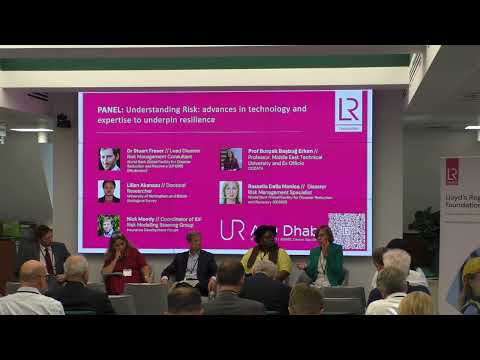
Session 3: Understanding Risk: advances in technology and expertise to underpin resilience
Drinks reception, including disaster risk game ‘Busy Mayors’
Event closes
A new report reveals that individual resilience across the world dropped between 2021 and 2023, increasing people's vulnerability.
A new report by a global safety charity has revealed community and societal resilience in Pakistan has been negatively impacted by recent experiences of disaster.
A new report by a global safety charity has highlighted significant gaps in access to disaster early warning systems in Central and West Africa, emphasising how much progress remains to be made by the UN’s ‘Early Warnings for All’ initiative.

