


Engineering X grants £1mil to improve engineering education
Engineering X gives £1 million worth of grants to projects across 14 countries to boost the quality of engineering education and training.
This page is approximately a 5 minute read
Inside a full-bridge simulator at the Athina Maritime Learning and Development Centre in Voula, a southern suburb of Athens, a group of deck and engine officers are planning a voyage. The vessel is an Aframax oil tanker in ballast condition. The route runs from Algeciras to Rotterdam.
In principle, the task is familiar: plan a safe and efficient passage. In practice, every decision now carries another layer of environmental thinking and responsibility. Fuel changeover. Waste management. Weather routing. Port requirements. Emissions. Compliance. Communication between ship and shore.
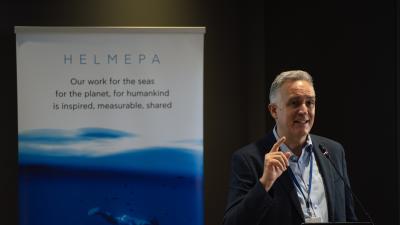
The Environmental Leadership Masterclass, a flagship training course developed under METAVASEA, is a four-year programme coordinated by the Hellenic Marine Environment Protection Association, HELMEPA, with the strategic and financial support of Lloyd’s Register Foundation.
Shipping carries around 90% of world trade and is under growing pressure to reduce emissions, adapt to new technologies and meet more demanding environmental expectations. That shift depends on both regulation and people: seafarers, port workers, shore-based teams and company leaders who have to turn new requirements into safe and workable practice.
“METAVASEA is, above all, an alliance,” says Constantinos Triantafyllou, Head of Maritime Affairs and Stakeholder Engagement at HELMEPA and METAVASEA Coordinator. “Eighteen partners, 83 participating organisations, and a network activating over 250 maritime stakeholders across Greece, Cyprus and the wider Eastern Mediterranean, united around a single purpose: placing people at the centre of shipping's green and digital transition.”
METAVASEA delivers training across environmental protection, decarbonisation, digital awareness, cybersecurity, port safety culture, weather routing, climate change impacts and soft skills. It has already engaged around 3,000 seafarers of 18 nationalities and maritime professionals in training and upskilling.
“The Masterclass demonstrated that environmental performance requires more than regulations,” says Capt. Emmanouil Marinakis, Navigation Safety Officer at Tsakos Shipping & Trading S.A. “It requires competent people, strong ship-shore cooperation, and the ability to turn knowledge into responsible everyday action.”
The need is clear in the programme’s own evidence base. The METAVASEA Wave 2 Survey Report, covering June 2024 to November 2025, gathered responses from more than 2,080 people across the Eastern Mediterranean, including shipping company representatives, seafarers, port administrations, service providers, suppliers and civil society representatives.
Among seafarers, crew fatigue driven by new regulatory requirements and additional workload remained the top safety concern, reported by 69% of respondents. Only 41% of seafarers in the combined dataset had received decarbonisation-related training in the previous two years.
At the same time, employers are placing greater value on the skills that help people adapt. Between survey waves, shipping companies increased their prioritisation of leadership, teamwork, resilience and adaptability, making soft skills the fastest-moving skill cluster in the dataset.
For Dr Ioannis Salamouris, President of KNOWL Social Enterprise, which delivered the soft skills module of the Masterclass, this is a vital layer of training.
“Soft skills are essential and non-negotiable in building strong leadership, at sea and ashore,” he says. “They are just as decisive in environmental leadership specifically, turning technical knowledge into decisions people actually trust and follow. Without them, even the right environmental strategy risks staying on paper instead of becoming daily practice.”
“Participating in the Environmental Leadership Masterclass helped me connect international policymaking with the realities of ship operations,” says Elena Matzaridou, Digital Strategy Advisor and HELMEPA member. “It made me understand how leadership, capacity building and organisational learning support the effective implementation of international environmental regulations.”
For seafarers, that connection is especially important. They are often the people required to implement new processes in real time, under operational pressure, with safety, compliance and environmental performance all in view. A regulation may be written ashore, but its success often depends on decisions made at sea.
Capt. Georgios Tzoumerkas, a Master Mariner and long-standing HELMEPA member, describes the Masterclass as both detailed and practical.
“The presenters created a truly interactive environment and covered every topic effectively,” he says. “This seminar was detailed, helpful and instructive for both seafarers and shore-based teams. We look forward to more initiatives like this.”
Environmental leadership requires shared understanding across vessels, offices, ports and supply chains. When crews are expected to manage new fuels, new reporting requirements, digital systems and changing weather patterns, shore teams also need the knowledge and leadership skills to support them.
HELMEPA is well placed to convene that work. Founded by the Greek shipping community in 1982, the organisation has a long-standing role in promoting safety at sea and protecting the marine environment among its membership, now comprising 389 shipping companies and maritime organisations, 2,500+ ocean-going vessels and 15,000 seafarers and maritime professionals. Through METAVASEA, it is working with partners across the Eastern Mediterranean to build capacity across the people and organisations that will shape maritime transition in practice.
Lloyd’s Register Foundation’s support reflects its wider commitment to improving safety across complex systems. In shipping, decarbonisation and digitalisation bring necessary progress, but also new pressures. If the workforce is not equipped to manage those pressures, then safety, resilience and business continuity are put at risk.
Back in the simulator, the officers planning the voyage are practising the decisions, conversations and trade-offs that increasingly define modern maritime work.
“Although an imaginary, simulated voyage of an ocean-going tanker through marine protected areas can only give an idea of the real work required onboard to protect the environment, we feel that it was made obvious to all, that it takes a lot of personal effort, a high level of environmental accountability, proactiveness and team work to make this voyage environmentally sustainable” says Stelios Volakis, Training Manager at Athina Maritime Learning and Development Centre of the Minerva Group of Companies.
The route from Algeciras to Rotterdam may be simulated, but the challenge is real. Shipping’s transition will be measured in technology, targets and regulation. Its success will depend on whether people have the confidence, skills and leadership to carry it through safely.
METAVASEA is, above all, an alliance. Eighteen partners, 83 participating organisations, and a network activating over 250 maritime stakeholders across Greece, Cyprus and the wider Eastern Mediterranean, united around a single purpose: placing people at the centre of shipping's green and digital transition.
Constantinos Triantafyllou Head of Maritime Affairs and Stakeholder Engagement at HELMEPA and METAVASEA Coordinator.
Engineering X gives £1 million worth of grants to projects across 14 countries to boost the quality of engineering education and training.
With funding from Lloyd's Register Foundation, Moi University has launched a groundbreaking new project to advance skills training for safer engineering.
Maritime Just Transition Task Force collaborative project sets framework to equip seafarers with skills as shipping transitions to zero emissions.

